
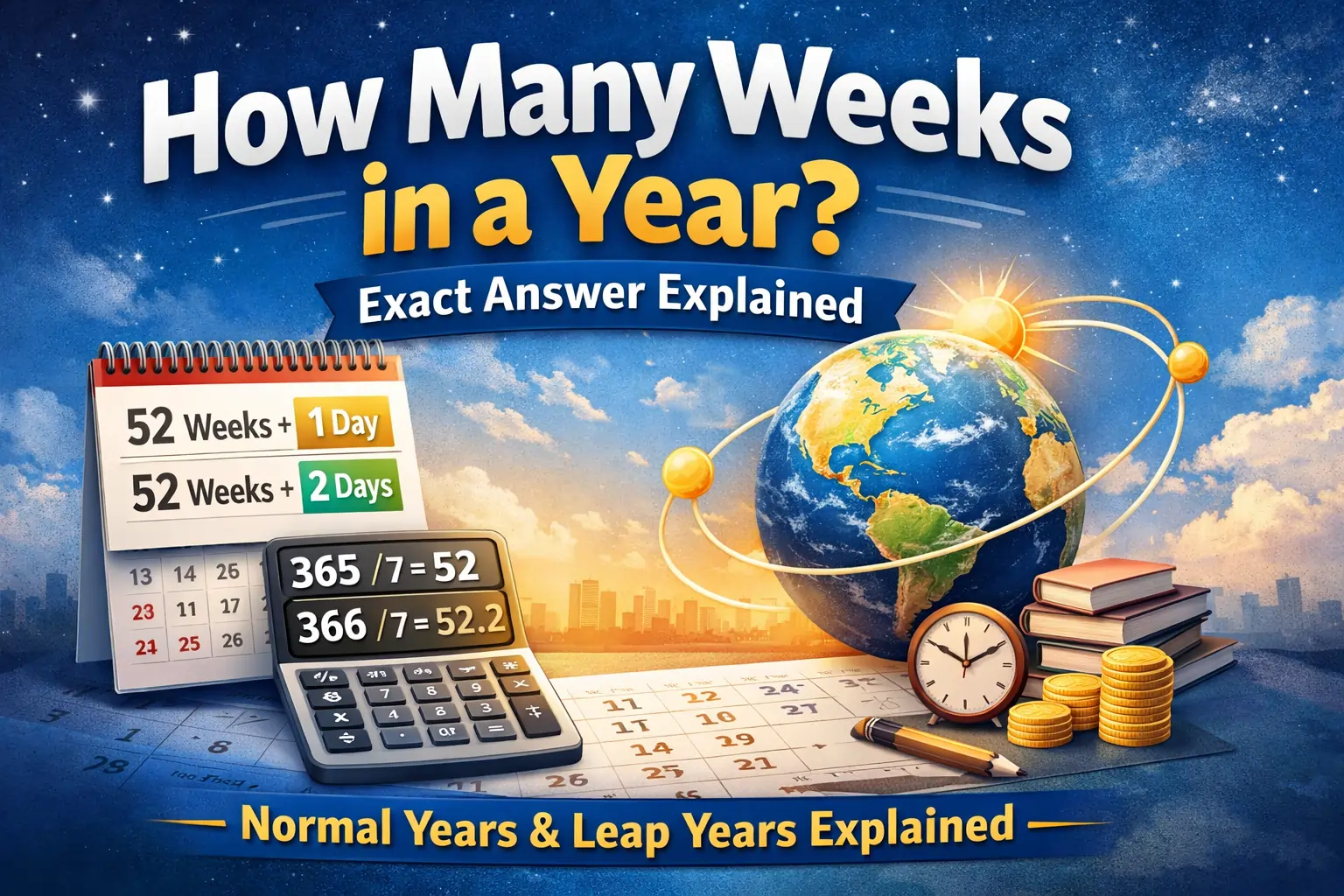
When I first asked how many weeks in a year, I expected a clean, neat answer. I got one. Mostly. A year has 52 weeks and 1 day in a normal year, and 52 weeks and 2 days in a leap year. That sounds simple enough, but the more I looked at it, the more I realized people get tripped up by this all the time.
I’ve seen people count weeks, plan goals, set work schedules, and even budget money around the wrong idea of a year. Then they wonder why their calendar feels off. It gets old fast. So I want to walk through how many weeks in a year in a way that actually makes sense, without turning it into a math lecture nobody asked for.
The Basic Answer
A normal year has 365 days. If you divide 365 by 7, you get 52 weeks and 1 day. That means there are 52 full weeks in a year, plus one extra day left over.
A leap year has 366 days. Divide that by 7 and you get 52 weeks and 2 days. So yes, the answer to how many weeks in a year is usually 52, but technically the year is a little longer than that. That little extra day matters more than people think.
I used to think a year was exactly 52 weeks. Sounds reasonable. It is not. There is always a leftover day, and that leftover day is the reason your dates slowly drift if you only think in weeks.
Why It Is Not Exactly 52 Weeks
Seven days make one week. Easy. But a calendar year is based on the Earth’s trip around the sun, and that trip does not line up perfectly with 52 weeks. It is closer to 365 days, not 364.
That missing day is why how many weeks in a year is not just “52” and done. A year is actually a bit more than 52 weeks. In practical terms, that extra day shows up as one extra date every year. In leap years, it shows up as two.
I remember once trying to plan a content schedule by saying, “I’ll just write one post per week for the whole year.” That sounded neat in my head. Then I hit the calendar math and realized I was off by a day. Not a disaster, but annoying enough to make me roll my eyes. Small mistake. Big enough to matter.
How Many Weeks in a Year for Work and Planning?
If you are using how many weeks in a year for work, payroll, project planning, or content schedules, the number people usually use is 52. That is the standard planning number because it is clean and useful.
But if you need accuracy, especially for budgets or time-based reporting, I would not stop there. A year is really 52 weeks plus a little extra. That extra bit can affect deadlines, pay cycles, and annual goals if you ignore it long enough.
I’ve seen this get messy in a simple way. Someone says, “We have 52 weekly meetings this year,” and then suddenly there is one more Monday on the calendar than expected. That is the kind of thing that makes people sigh in meetings and stare at a screen like the calendar personally offended them.
How to Calculate It Yourself
If you ever want to check how many weeks in a year on your own, the math is very simple:
365 ÷ 7 = 52 remainder 1
That means 52 full weeks and 1 extra day.
366 ÷ 7 = 52 remainder 2
That means 52 full weeks and 2 extra days.
I like this kind of math because it does not pretend to be fancy. It is just division. No drama. No weird formulas. And once you see it laid out, the whole question of how many weeks in a year stops feeling confusing.
What About Leap Years?
Leap years happen because the Earth does not take exactly 365 days to orbit the sun. It takes a little longer than that, so the calendar adds one extra day every four years or so. That is why February sometimes has 29 days instead of 28.
So when people ask how many weeks in a year during a leap year, the answer is still 52 weeks, but there are 2 extra days left over instead of 1. That is why leap years feel slightly different when you are counting dates across the full year.
I know that sounds tiny, but tiny things add up. If you are planning payments, school schedules, or recurring tasks, that extra day can shift things just enough to throw you off. I have made that mistake before, and it is one of those mildly irritating problems that should not be a problem, but somehow is.
How Many Weeks in a Year by Month?
People often ask how many weeks in a year because they are trying to estimate monthly or yearly work. So here is the part that helps in real life: most months have about 4 weeks, but not exactly.
Some months have a little more than 4 weeks. Some have 5. That is why monthly planning sometimes feels uneven. A month can look neat on paper and still be a pain to schedule in practice.
I usually think of it like this. A month is not a week-shaped box. It is a weird little container with different numbers of days inside it. So if you are trying to break a year into equal chunks, weeks are usually easier than months. Still, even weeks do not make the year perfect. That is the part people forget.
How Many Weeks in a Year for Salary and Payroll?
This is where the question gets practical fast. If someone is salaried, weekly, or monthly paid, they often want to know how many weeks in a year for budget planning.
For weekly pay, people usually use 52 weeks. That is the usual payroll baseline. But again, the real calendar has 52 weeks and extra days, so depending on the exact pay cycle, you may end up with 53 pay periods in a year. That can happen and it can confuse people who were not paying attention.
I have seen this catch people off guard. They budget for 52 checks, then a 53rd one shows up and they think they hit some kind of bonus. Sometimes it is a nice surprise. Sometimes it is just a calendar quirk. Either way, knowing how many weeks in a year helps you avoid bad math.
Why People Search This So Often
Honestly, I think people search how many weeks in a year because they want a fast answer they can trust. They are not usually looking for astronomy. They just want to know how to count time without messing up.
I get that. I have done the same thing. I wanted to know whether a year had 52 exact weeks, whether a leap year changed that, and how to use the number in planning. The answer is simple, but the details matter. That is usually how these things go.
Also, there is something oddly satisfying about turning a vague question into a clean number. 52 weeks. 1 extra day. Done. That is the kind of answer that makes a calendar feel less annoying for about five minutes.
A Quick Real-World Way to Think About It
When I think about how many weeks in a year, I do not just think “52” and stop. I think “52 weeks, plus a little extra.” That keeps me from making sloppy assumptions.
If I am planning a yearly routine, I use 52 weeks as the base. If I need precision, I remember the extra day or two. That small habit saves me from a lot of annoying little mistakes. It is not fancy. It just works better.
And to be blunt, using only 52 and forgetting the rest is fine for rough planning, but it is pretty mediocre if you need accuracy. There is no other way to put it. Good enough is not always good enough.
Common Mistakes People Make
One mistake is assuming every year has exactly 52 weeks and nothing else. That is wrong. Another mistake is thinking leap years somehow add a whole extra week. They do not. They only add one extra day.
Another one I see all the time is people mixing up weeks in a year with weeks in a month. That gets messy fast. A month is not four exact weeks, and a year is not 12 exact four-week blocks. If it were, life would be much easier. It is not.
I have also seen people use the wrong number in annual planning spreadsheets and then act surprised when totals do not line up. That one always makes me laugh a little, because the spreadsheet is not broken. The math was just lazy.
So, How Many Weeks in a Year?
If you want the clean answer, how many weeks in a year is 52 weeks.
If you want the exact answer, a normal year has 52 weeks and 1 day, and a leap year has 52 weeks and 2 days.
That is the whole thing. Simple on the surface, a little messier underneath. That is usually how calendar math goes.
FAQ’s
Is a year 52 weeks exactly?
No. A year is 52 weeks plus 1 day in a normal year, or 52 weeks plus 2 days in a leap year.
Why do people say 52 weeks in a year?
Because it is the easiest practical number to use for planning. It is close enough for most everyday stuff.
Does a leap year have 53 weeks?
No. It still has 52 weeks. It just has 2 extra days left over instead of 1.
How many weeks are in 365 days?
365 days equals 52 weeks and 1 day.
How many weeks are in 366 days?
366 days equals 52 weeks and 2 days.
Final Take
If someone asks me how many weeks in a year, I keep it simple: 52 weeks is the answer most people use, but the exact calendar count is a little over that. I like knowing the exact version because it keeps my planning cleaner and my expectations realistic.
That tiny extra day may not sound like much. But it is the difference between a rough estimate and a proper answer. And when you are organizing a year, even one day can matter more than people admit.
