
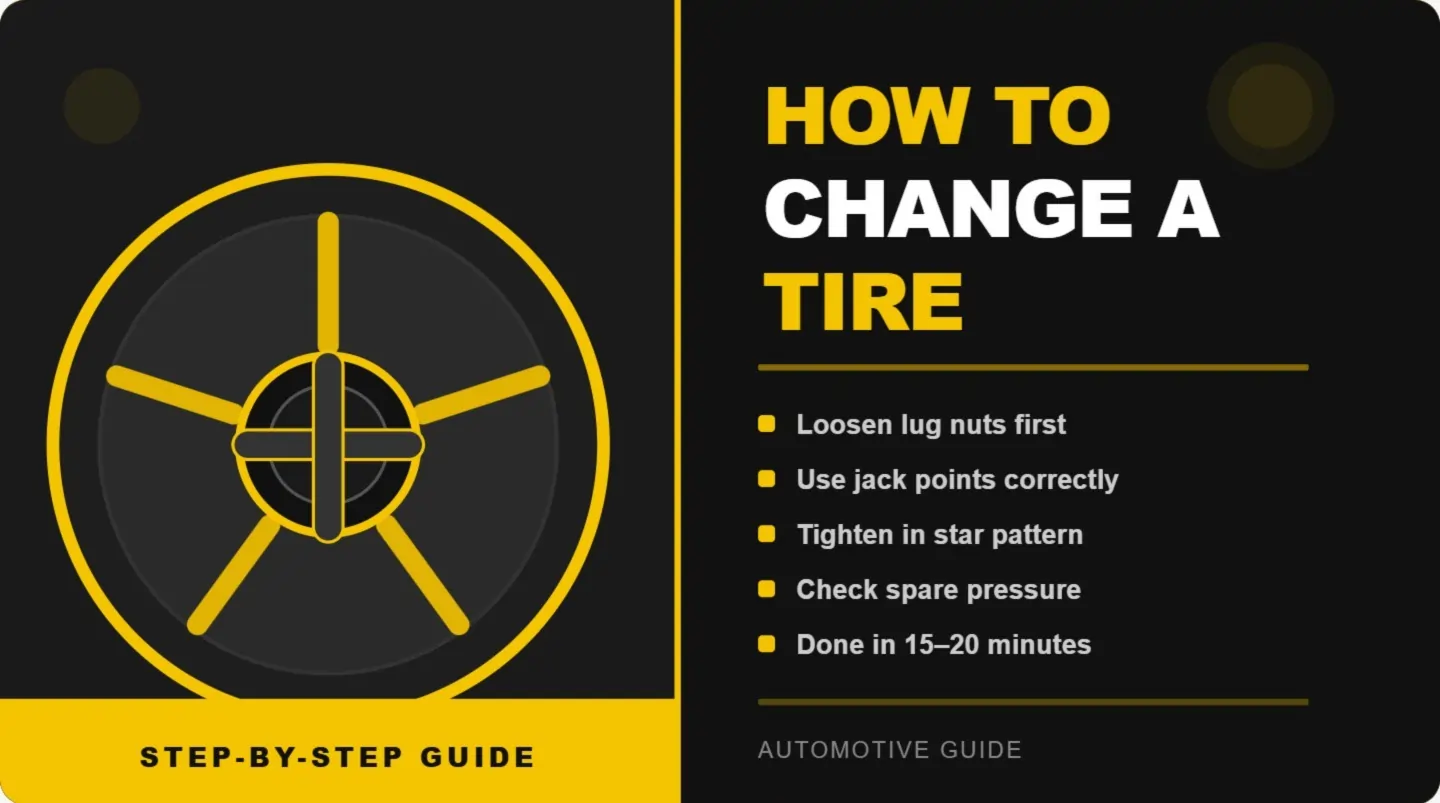
You’re on the side of the road, cars flying past, and your tire is completely flat. Knowing exactly what to do next can save you an hour of waiting — and this guide will walk you through every step.
What You Need Before You Even Touch the Tire
You can’t change a tire without the right tools. Most cars already have everything you need — but if you’ve never checked, now is the time.
What should be in your trunk?
Open your trunk and look for three things: a spare tire, a jack, and a lug wrench. These usually come bundled together, often tucked under the floor mat or mounted underneath the vehicle’s rear. If any of these is missing, replace it now — not after a blowout at midnight.
Some vehicles also carry a torque wrench or wheel wedges. You don’t need those to get the job done, but they help.
One thing most drivers overlook
Your spare tire needs air pressure too. Most drivers never check it, and then they’re stranded with a flat spare on top of a flat tire. Check your spare’s pressure every time you rotate your tires — about every 5,000 to 7,500 miles.
How to Change a Tire Step by Step
Step 1: Get off the road safely
The moment you feel a flat, don’t slam the brakes. Ease off the gas, grip the steering wheel firmly, and pull off to a flat, stable surface — ideally a parking lot or a wide shoulder. Avoid soft ground. A jack sinking into dirt mid-change is dangerous.
Turn on your hazard lights immediately.
Step 2: Secure the vehicle
Before you lift anything, shift into park if you’re driving an automatic. For a manual transmission, put it in first gear or reverse. Place wheel wedges or rocks behind the tires that aren’t being changed — this prevents rolling.
And never crawl under a car that’s on a jack. Not even briefly.
Step 3: Loosen the lug nuts before jacking
This part surprises most beginners. You need to loosen the lug nuts while the tire is still on the ground — not after. If you try to turn them with the wheel in the air, the tire just spins.
Use your lug wrench and turn counterclockwise. If the nuts are stuck, use your body weight — stand on the wrench and push down. You only need to break them loose, about a half-turn each. Don’t remove them yet.
Step 4: Position the jack correctly
Every car has designated jack points — reinforced spots under the frame built to take the weight. If you put the jack anywhere else, you risk denting the undercarriage or, worse, the car tipping off the jack entirely.
Check your owner’s manual for the exact location. Most vehicles have a notch or marker just behind the front wheels and just ahead of the rear wheels. You’ll feel the jack seat firmly when it’s in the right spot.
Step 5: Raise the vehicle
Crank the jack slowly until the flat tire is about 6 inches off the ground. Don’t go higher than necessary.
Keep people away from the car while it’s on the jack. If the car starts tilting at all, lower it and reposition.
Step 6: Remove the flat and mount the spare
Now fully remove the lug nuts and set them somewhere you won’t lose them — your pocket works. Pull the flat tire straight toward you and set it flat on the ground.
Lift the spare and align the holes with the bolts. Push it fully onto the hub. Hand-tighten the lug nuts in a star pattern — not in a circle. Opposite pairs, working across the wheel. This distributes pressure evenly and prevents warping.
Step 7: Lower and fully tighten
Lower the jack until the spare touches the ground — but not fully down yet. Now tighten the lug nuts with the wrench as firmly as you can manage. Then lower the rest of the way, remove the jack, and give the nuts one final check.
Don’t skip the final tightening. Vibration on a loose wheel is how people lose a tire at highway speed.
After the Change: What You Must Do Next
Check the spare tire type
Most cars carry a compact spare — sometimes called a donut — that’s smaller than a regular tire. These are not meant for long distances. Most compact spares are rated for a maximum of 50 miles at speeds no higher than 50 mph.
If your spare is full-size, you have more flexibility. But you should still get the flat repaired or replaced as soon as possible.
Get to a shop the same day if you can
Driving on a spare changes your vehicle’s handling, especially in corners. And because spare tires often have different tread depth from your other three tires, your all-wheel-drive system — if you have one — can actually sustain damage. Most manufacturers recommend not running an AWD vehicle on a mismatched spare for any longer than absolutely necessary.
FAQ’s
How long does it actually take to change a tire?
Once you’ve done it once or twice, 15 to 20 minutes is realistic. The first time usually takes 30 to 45 minutes. The biggest time sink is almost always finding the jack points and getting the lug nuts loose.
Can I change a tire in the rain?
Yes, but take extra precautions. Get as far off the road as possible, keep your hazards on, and avoid touching the vehicle’s metal frame if there’s lightning. The main mechanical process doesn’t change.
What if I can’t loosen the lug nuts at all?
Some lug nuts are torqued to 80–100 ft-lbs at the shop using an impact wrench. Standing on the lug wrench usually works. If not, a breaker bar extension or a call to roadside assistance are your options — don’t try to force it with excessive leverage or you risk snapping a stud.
Do I need to replace all four tires if one goes flat?
Not necessarily — it depends on the remaining tread depth. If the other three tires are still in good shape, you can often replace just the flat. But if the tread difference between tires is more than about 2/32 of an inch, some mechanics recommend replacing in pairs or all four, especially on AWD vehicles.
Is it safe to drive slowly to a gas station on a completely flat tire?
Only for a very short distance — and only if stopping where you are is genuinely more dangerous than moving. Even a few hundred yards at low speed on a flat can destroy the rim, which turns a $150 tire repair into a $400+ rim replacement.
