
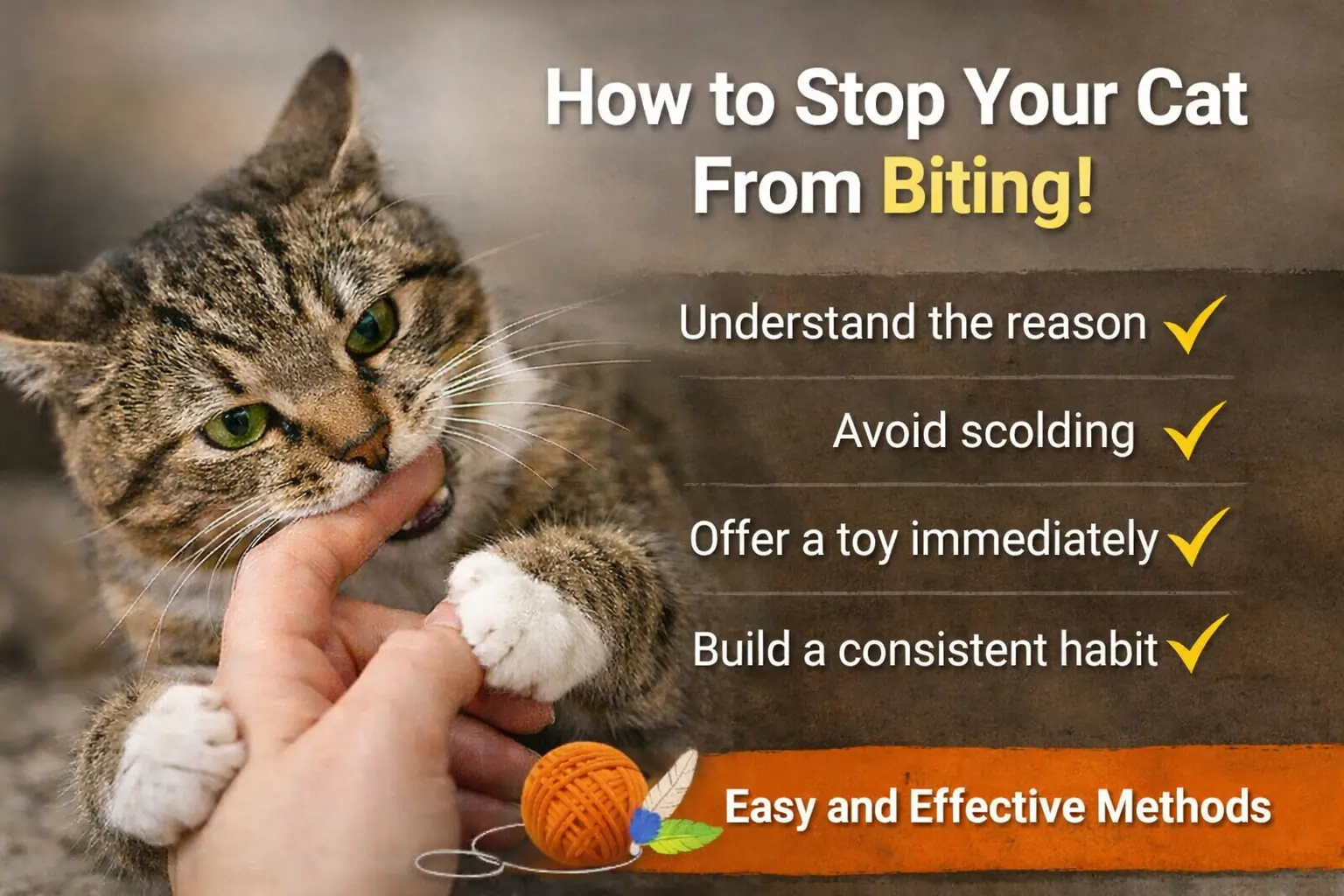
Your cat doesn’t bite without a reason. There is a reason for it to bite every time. And once you understand the reason, half the problem is solved. This article will explain to you a simple and easy way to control your cat’s biting habit without causing any harm.
Why Does a Cat Bite You?
Play biting is the most common one
Most cats bite while playing. This is normal for them because they naturally play hunt. Especially small cats, they bite hands or feet, mistaking them for prey. This is normal for them, and we think that maybe they are biting. And one more thing, if a cat does not learn all this in childhood, it will not be able to catch its prey. Therefore, a cat has to learn all this to catch its prey.
Petting can go from nice to irritating fast
Some cats enjoy touch for a minute, then suddenly decide they have had enough. Cornell describes this as petting-induced aggression, and it often comes with dilated pupils, tail lashing, and ears moving back before the bite happens. The cat is usually not being random. It is trying to end the interaction.
Pain, fear, or redirected stress can be the real reason
If your cat started biting more suddenly, pain matters. Cornell and ASPCA both note that pain and medical issues can drive aggression, and even a painful touch or movement can trigger a bite. A cat can also bite after a loud noise, another animal outside the window, or a stressful moment in the house when the stress gets redirected.
What to do the moment your cat bites
Stop the interaction immediately
The second teeth touch skin, end the game. Do not keep petting, do not hold your hand there, and do not try to talk the cat out of it with pressure or force. Cornell specifically recommends stopping contact and using a cooling-off period with no physical touch when petting aggression shows up.
Don’t punish the cat
Yelling, spraying, or grabbing usually makes things worse. Cornell and the MSD Veterinary Manual both warn that punishment and confrontational training can increase fear, avoidance, and aggression, which means you may get more biting, not less. Your cat needs a clear lesson, not a scary one.
Redirect to something safe
If the bite happens during play, move the energy to a toy, not your hand. Wand toys, rope toys, and chase toys give your cat the same hunting outlet without teaching it that fingers are prey. The goal is simple: make the toy the target and your skin the boring option.
How to break the biting habit for good
Teach your cat that hands are not toys
This part sounds basic, but it matters. Never wiggle fingers in front of your cat to get a reaction, and do not let kids roughhouse with hands or feet. Cats learn through repetition, so every time your hand becomes a toy, you make the habit stronger.
End attention when biting starts
If your cat bites for attention, the reward has to disappear the instant the bite happens. Cornell recommends withdrawing attention completely, leaving the room if needed, and returning only when the cat is calm. That is the lesson. Biting makes you go away. Calm behavior brings you back.
Give a replacement behavior
A cat cannot bite and do a polite alternative at the same time. Cornell notes that you can teach a behavior that does not fit with biting, such as sitting on a mat or offering a high-five, then reward that instead of the nip. This works because you are not only stopping the bad move, you are giving the cat a better one.
How to pet a cat that bites during cuddles
Watch the warning signs
Most cats tell you they are done before they bite. Look for tail twitching, ears moving back, pupils getting larger, restlessness, head turning toward your hand, or skin that starts to ripple under your fingers. Humane World and Cornell both point to these signals as the moment to stop, not the moment to keep going.
Keep petting sessions short
Start with very brief strokes, then stop while things are still good. Cornell recommends rewarding brief, light stroking without signs of aggression and slowly increasing duration over time. That means you end on a good note before your cat hits the point of no return.
Avoid grabbing, restraining, or hovering
Many cats dislike restraint, even when the touch itself is fine. VCA notes that some cats experience petting as a form of control or restraint, which can push them into biting, and Cornell recommends avoiding uninvited handling or attempts to pick the cat up while it is eating. Let the cat choose closeness more often.
How to reduce play biting in kittens and young cats
Burn off energy before it turns into a bite
Under-stimulation is a big reason for play aggression. VCA says that unused energy and too little appropriate play can lead to rough, people-directed biting, so the fix is more interactive play, not less. Aim for active sessions with wand toys, chase toys, and movement that lets your cat stalk and pounce on something that is not you.
Make the right thing easy to grab
Keep toys near the couch, bed, and any place where biting usually starts. If you always have a toy ready, you can swap in the toy before your hand becomes the target. Kitten and young-cat biting often improves when the cat has a better outlet that feels just as exciting.
Stay boring when the bite starts
Do not flail, do not chase, and do not turn the moment into a big reaction. That kind of response can feel like part of the game to a playful cat. End the interaction, walk away, and come back later with a toy or a calmer setup.
When biting may be a medical problem
Sudden changes deserve a vet visit
If a gentle cat suddenly starts biting, especially when touched, a medical cause should be ruled out. ASPCA says several health issues can contribute to aggression, including arthritis, dental disease, abscesses, hyperthyroidism, epilepsy, trauma, and cognitive decline in older cats. Cornell also notes that cats in pain may bite to avoid touch or movement that makes things worse.
Pain bites often have a pattern
Pain-related biting often happens in the same spot or during the same action. A cat with aching joints may hate being picked up, a cat with dental pain may react around the face or mouth, and a cat with skin discomfort may snap when touched on the back or belly. That pattern is useful because it tells your vet where to look first.
What to do about bite wounds
Take broken skin seriously
Cat bites can create deep puncture wounds that trap bacteria under the skin. VCA says cats carry bacteria in their mouths that can cause infection, and it advises seeing a physician as soon as possible for proper treatment. Mayo Clinic also notes that deep punctures, heavy bleeding, or signs of infection need medical attention.
Clean the wound and watch for infection
Wash the area right away and keep an eye out for redness, swelling, increasing pain, drainage, or fever. Cat bite infections can develop quickly, so do not wait around hoping it settles on its own. That is especially true for bites to the hand, because those can become serious fast.
A simple routine that helps most cats
Build a calmer day, not just a calmer moment
Cats that bite from boredom or overstimulation usually need a better rhythm, not one dramatic correction. Add a few short play sessions, keep petting brief at first, and stop before the cat gets wound up. For many homes, that single change lowers biting more than any spray bottle or harsh correction ever will.
Keep the rules the same every time
Consistency matters more than intensity. If biting sometimes gets a big reaction, sometimes gets cuddles, and sometimes gets ignored, your cat never learns the pattern. Pick one response, use it every time, and make sure everyone in the house does the same thing.
FAQ’s
Q1. Why does my cat bite me when I pet her?
Usually, because the cat has reached her limit. Cornell says petting-induced aggression can happen when a cat is overstimulated or trying to control when the petting stops, and the warning signs often show up just before the bite.
Q2. How do I stop my kitten from biting my hands?
Stop using your hands as play objects, end the game the second biting starts, and redirect to a toy every time. ASPCA and VCA both note that kittens and young cats learn bite habits through play, so consistency is what changes the behavior.
Q3. Should I yell no when my cat bites?
No. Punishment can increase fear and aggression, and it usually teaches the cat to fear you rather than to stop biting. A calm stop-and-leave response works better than a loud correction.
Q4. Why does my cat bite me then walk away?
That often happens when the cat is overstimulated, wants the interaction to end, or was using the bite as a quick boundary. It can also happen during play, especially in cats that are not getting enough acceptable outlets for hunting behavior.
Q5. When should I worry about cat biting?
Worry when the biting is sudden, more intense than usual, linked to being touched in one area, or happening with other changes like hiding, limping, poor appetite, or irritability. Those patterns can point to pain or illness, and ASPCA and Cornell both recommend a veterinary exam when aggression may be medically driven.
Q6. Is a cat bite dangerous for people?
It can be. Cat bites are puncture wounds that can trap bacteria and become infected quickly, and medical care is often recommended when the skin is broken.
Conclusion
The fastest way to stop cat biting is to figure out which kind of biting you are dealing with. Play biting needs better play, petting biting needs shorter and gentler contact, and sudden biting may need a vet because pain or illness could be behind it. Punishment usually makes the problem worse, but clear timing and consistent redirection can change it.
Start with one rule today. End every bite, every time, and give your cat a better outlet before the next one starts.
